

Focus is not a switch you flip with one “brain-boosting” ingredient. It is a brain function shaped by sleep, hydration, food, movement, stress and the way you structure your attention. When those foundations are in place, a carefully chosen supplement may have a supporting role—but it should never be asked to do the work of an entire routine.
If you are looking for healthy brain and focus ingredients, start with the ones your body uses every day: water, protein-rich foods, unsaturated fats, colorful plants and key vitamins and minerals. Then look at emerging options such as lion's mane with clear eyes: promising, but not proven to deliver all-day focus.
What does “healthy focus” actually mean?
Focus is your ability to direct attention, resist distractions and hold useful information in mind long enough to act on it. These skills are often grouped under executive function. They help you plan, prioritize, switch tasks and finish what you start.
A healthy brain needs more than stimulation. It needs enough recovery to maintain attention, enough fluid to function normally, and regular energy from food. The goal is not superhuman productivity. It is steadier clarity without repeatedly borrowing from tonight's sleep or tomorrow's energy.
Why your focus can fade before the day is over
An afternoon dip can come from several ordinary causes at once: a short night, hours without a break, too little water, a skipped meal, stress or a noisy environment. The CDC notes that adequate sleep supports attention and memory. A systematic review also found that dehydration is associated with poorer cognitive performance and that improving hydration status may help some aspects of attention and inhibitory control, although results vary across studies.
That is why the first question should not be, “Which supplement am I missing?” It should be, “Which basic need is my brain asking me to meet?”
6 ingredients and habits that support a healthy brain
1. Water
Your brain depends on adequate hydration, but you do not need to force excessive amounts. Drink regularly, use thirst and urine color as practical cues, and increase fluids when heat or activity calls for it. Keeping water visible is often more useful than relying on willpower.
2. Protein-rich foods
Eggs, fish, yogurt, beans, lentils, tofu and other protein-rich foods provide amino acids used throughout the body. Pairing protein with fiber-rich carbohydrates and healthy fats can make a meal more satisfying and help you avoid becoming distracted by hunger.
3. Unsaturated fats, especially food sources of omega-3s
Fatty fish, walnuts, chia seeds and ground flax can be part of a brain-friendly eating pattern. Importantly, food and supplements are not interchangeable. The NIH's NCCIH says the most consistent positive findings are associated with dietary patterns that include fish, while evidence for omega-3 supplements in treating cognitive decline is not convincing.
4. Colorful plants
Berries, leafy greens, peppers, beans and other plant foods bring fiber, vitamins, minerals and varied plant compounds to the plate. You do not need a perfect “brain diet.” A practical target is more variety across the week.
5. Sleep and a consistent wake time
Sleep is not an ingredient, but it is one of the strongest inputs into next-day attention. Protect a repeatable sleep window, dim bright light in the evening and talk with a healthcare professional if sleep problems are frequent or persistent. Caffeine can temporarily increase alertness, but it does not replace recovery.
6. Movement and attention breaks
Regular physical activity supports overall health, including brain health. A short walk or movement break also changes your environment and gives your eyes a rest. Evidence about an immediate cognitive lift from brief breaks is mixed, so treat movement as a healthy routine—not a guaranteed productivity hack.
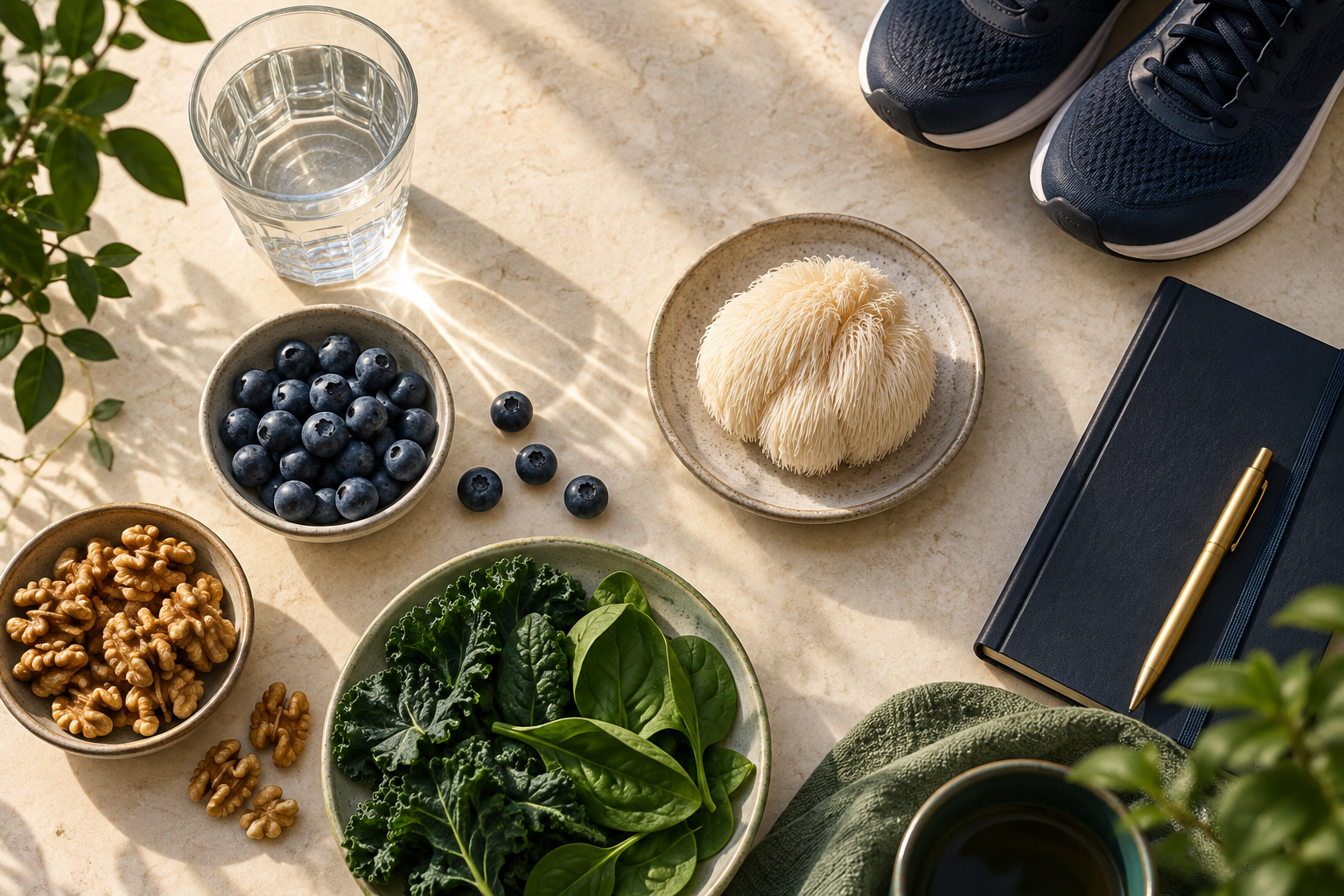
Where lion's mane may fit
Lion's mane (Hericium erinaceus) is an edible mushroom being studied for possible effects on cognition and mood. It is a sensible product to discuss within the Smyle Mind collection because the research question is relevant to attention and cognitive wellness. But “being studied” is not the same as “proven to work.”
In a small 2009 randomized, placebo-controlled trial, 30 adults with mild cognitive impairment took lion's mane or placebo for 16 weeks. Cognitive scores improved during supplementation, then declined after it stopped. A 2023 pilot trial in 41 healthy adults found faster performance on one task after a single dose, but it also reported null and limited negative findings. The authors explicitly called for larger studies.
A 2025 systematic review reached a similarly cautious conclusion: clinical research is limited by small samples, short study periods and differences among the lion's mane preparations tested. These differences matter. Research on one extract, dose or population cannot automatically substantiate claims for every lion's mane product.
Why Smyle Lion's Mane Mushroom is the product fit

Smyle Lion's Mane Mushroom is the most relevant product in the current Smyle range for readers exploring this ingredient. Its role in this article is ingredient-led rather than stimulation-led. Follow the current product label, and do not assume that a higher amount will deliver a stronger result.
Because formulas and labels can change, review the live Supplement Facts, suggested use and warnings before purchase. If you are pregnant or nursing, take medication, have a medical condition, have a mushroom allergy or are considering a supplement for a child, speak with a qualified healthcare professional first.
Explore Smyle Lion's Mane Mushroom
A realistic all-day focus routine
- Morning: get daylight, drink water, eat a balanced meal and choose the day's most important task.
- Mid-morning: work in a protected block with notifications silenced.
- Lunch: include protein, plants and a fiber-rich carbohydrate; drink to thirst.
- Afternoon: stand, walk or look away from the screen before automatically reaching for more caffeine.
- Evening: set a stopping point so today's unfinished work does not consume tonight's recovery.
Start with one change you can repeat. A bottle of water within reach, a more balanced lunch, a ten-minute walk or a protected bedtime will usually tell you more about your focus than stacking several new ingredients at once.
Frequently asked questions
What ingredients are best for a healthy brain and focus?
No single ingredient guarantees focus. A varied diet with adequate fluid, protein-rich foods, unsaturated fats, fruits and vegetables provides the strongest everyday foundation. Sleep, movement and fewer distractions also matter.
Does lion's mane improve focus?
Small human trials suggest possible benefits on selected cognitive measures, but results are mixed and the evidence is not strong enough to promise dependable focus. Larger, longer and product-specific trials are needed.
How long does lion's mane take to work?
Research has tested both single doses and several weeks of use, with inconsistent results. There is no established timeline that applies to every person or product. Follow the label and avoid treating a supplement as a quick fix.
Can lion's mane replace sleep or caffeine?
No. It cannot replace adequate sleep, and it should not be presented as a caffeine substitute with an equivalent effect. It is a different ingredient with a much smaller human evidence base.
References
- Centers for Disease Control and Prevention. About Sleep.
- Wittbrodt MT, Millard-Stafford M. Does Hydration Status Influence Executive Function? A Systematic Review. Journal of the Academy of Nutrition and Dietetics. 2021.
- National Center for Complementary and Integrative Health. Dietary Supplements and Cognitive Function, Dementia, and Alzheimer's Disease.
- Mori K, et al. Improving effects of the mushroom Yamabushitake (Hericium erinaceus) on mild cognitive impairment. Phytotherapy Research. 2009;23(3):367-372.
- Docherty S, Doughty FL, Smith EF. The Acute and Chronic Effects of Lion's Mane Mushroom Supplementation on Cognitive Function, Stress and Mood in Young Adults. Nutrients. 2023;15(22):4842.
- Ahmed M, et al. Benefits, side effects, and uses of Hericium erinaceus as a supplement: a systematic review. Frontiers in Nutrition. 2025.
Editorial note: This article is for general educational purposes and is not medical advice. Evidence discussed for an ingredient does not establish that a particular finished product will produce the same result.
*These statements have not been evaluated by the Food and Drug Administration. This product is not intended to diagnose, treat, cure or prevent any disease.
Dietary supplements do not replace a varied diet, sufficient sleep, regular movement or professional medical care. Follow the current label. Stop use and seek medical advice if you experience an adverse reaction. Keep out of reach of children.